How AI is revolutionizing personalized learning
Remember that student in your class who always seemed to get it before anyone else? Or the one who needed just a little more time and a different explanation? I’ll never forget Sar...
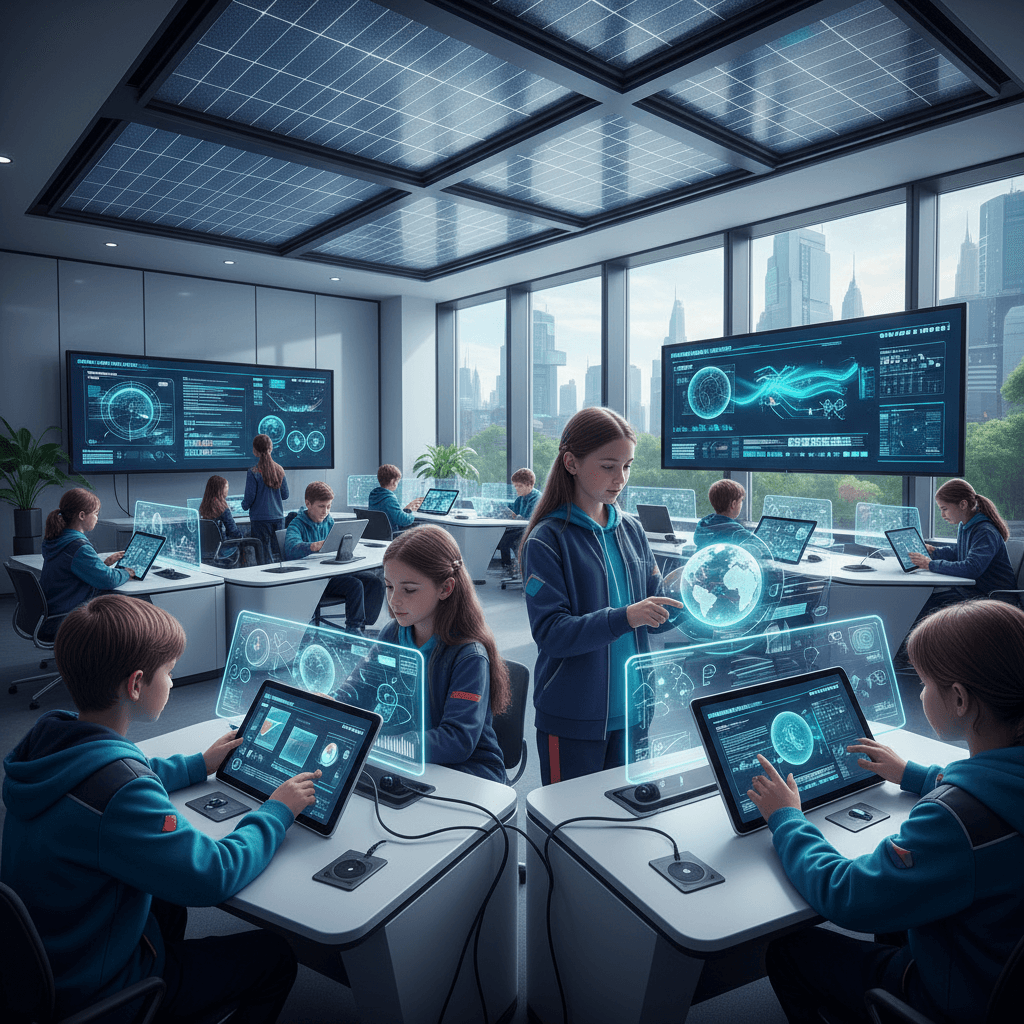
Remember that student in your class who always seemed to get it before anyone else? Or the one who needed just a little more time and a different explanation? I’ll never forget Sarah from my tenth-grade English class—she could analyze Shakespeare like a literature professor, but algebraic equations might as well have been ancient hieroglyphics. Meanwhile, her lab partner Michael aced calculus but struggled to write a coherent paragraph.
For centuries, education has operated like a factory assembly line—same lessons, same pace, same tests for everyone. We’ve known this doesn’t work perfectly, but what alternative did we have? Teachers can’t possibly create thirty different lesson plans for thirty different students.
But what if something could?
The Quiet Revolution in Our Classrooms
I was visiting my cousin’s middle school classroom last month when I noticed something different. Instead of thirty students working on the same math problems, they were scattered around the room—some on tablets, others working in small groups, a few getting one-on-one time with the teacher. When I asked my cousin about it, her eyes lit up. “It’s the AI learning platform we’re piloting,” she explained. “It understands where each student is struggling and adapts accordingly.”
This isn’t science fiction anymore. Artificial intelligence education tools are quietly transforming learning spaces from standardized factories into personalized journeys. The technology recognizes that Sarah and Michael don’t just learn at different paces—they learn in different ways, have different gaps in their knowledge, and need different types of explanations.
The magic happens through machine learning algorithms that analyze how students interact with material. When Michael gets stuck on a writing assignment, the system recognizes this isn’t his first struggle with organizing ideas—it’s part of a pattern. Instead of just marking his paper with red ink, it offers targeted exercises to build exactly the skills he’s missing.
How Smart Tutoring Actually Works
Let me tell you about James, a college freshman I tutor who was barely passing his introductory biology course. He’d read the textbook, attend lectures, but come exam time, he’d freeze. Then we started using an AI-powered study tool that adapted to his learning patterns.
The system noticed something fascinating—James could recall facts perfectly but struggled with applying concepts to new scenarios. Instead of making him reread the same material, it started giving him progressively more challenging application questions. When he stumbled on cellular respiration, it detected the specific misunderstanding (he confused the Krebs cycle with electron transport) and provided a custom-made analogy about energy production that finally made it click.
The most powerful educational technology doesn’t just deliver information—it understands the learner.
This is where tools like QuizSmart come into the picture. Imagine having a study partner that knows exactly which concepts you need to review before your big exam. Rather than wasting time on material you’ve already mastered, it focuses your energy where you’ll get the most benefit. For teachers, this means they can see exactly which students need help with specific topics—not just who’s “falling behind” in general.
When Algorithms Understand Students Better Than We Do
Mrs. Patterson, a veteran history teacher at my old high school, shared a story that stuck with me. She’d been teaching the Civil War for twenty years, and every year, students struggled with the same concepts. But last semester, her AI teaching assistant flagged something unexpected—students weren’t confusing the dates or battles as she’d assumed. They fundamentally didn’t understand the economic factors leading to the war.
The AI had analyzed their responses and identified the root misunderstanding. Mrs. Patterson adjusted her lessons accordingly, spending less time on memorization and more on economic contexts. Test scores improved dramatically, but more importantly, she told me, “The quality of their essays showed they actually understood the why, not just the what.”
This is the promise of artificial intelligence education—not replacing teachers, but giving them superpowers. The technology handles the data analysis and pattern recognition, freeing educators to do what humans do best: inspire, mentor, and connect.
The Human Touch in an AI World
Now, I know what some of you might be thinking—will robots replace teachers? Having seen these systems in action, I can confidently say the opposite is true. The most effective implementations I’ve witnessed actually create more meaningful human interaction.
Consider Mr. Davis’s fourth-grade classroom, where AI handles routine skill practice and assessment. This gives him thirty extra minutes each day for what he calls “magic time”—one-on-one reading with students, science experiments, art projects, and those spontaneous teachable moments that algorithms could never replicate.
The technology works best when it handles the repetitive tasks (grading, basic skill reinforcement, progress tracking) so teachers can focus on higher-order teaching. It’s about augmentation, not replacement.
Your Turn to Experience the Shift
So where do we go from here? The educational technology landscape is evolving rapidly, but the most effective tools share common traits—they’re adaptive, intuitive, and designed to support rather than replace human teachers.
If you’re a student, consider trying an AI learning platform for your next challenging subject. Notice how it adapts to your unique learning style. If you’re an educator, explore how these tools can give you deeper insights into your students’ needs. The goal isn’t perfection—it’s progress. It’s about creating learning experiences where Sarah can thrive in literature while Michael excels in mathematics, and both feel equally valued and supported.
The future of education isn’t about choosing between technology and humanity—it’s about leveraging technology to enhance what makes us human. And that’s a revolution worth embracing.