How to create a distraction-free study environment
Remember that time you sat down to study with grand intentions, only to find yourself three hours later having meticulously organized your pencil case, deep-dived into your friend’...
Remember that time you sat down to study with grand intentions, only to find yourself three hours later having meticulously organized your pencil case, deep-dived into your friend’s cousin’s vacation photos on Instagram, and learned exactly nothing about the French Revolution? Yeah, me too. It’s a universal student experience. You have the willpower, you have the notes, but the environment itself seems to be conspiring against you.
I recall one particularly brutal finals week in college. I was "studying" in my dorm's common room, a space that was a vortex of distraction. Someone was always microwaving popcorn, a TV was blaring a game, and a heated debate about the best 90s sitcom was perpetually underway. After two hours, I had re-read the same paragraph on macroeconomic policy seven times and had a strong opinion on Friends vs. Seinfeld, but my understanding of fiscal policy was unchanged. It was a breaking point. I realized that my effective studying wasn't about grinding for more hours; it was about creating a sanctuary where those hours could actually count. This isn't just about finding a quiet spot; it's about architecting an ecosystem for your mind to thrive.
Why Your Brain Craves a Sanctuary, Not Just a Desk
Our brains aren't designed to focus in chaos. Every ping from your phone, every conversation in the background, every visual clutter on your desk is a tiny cognitive tax. It forces your brain to switch contexts, and that switching has a real cost. Researchers call it "attention residue"—where part of your mind is still stuck on the previous task, making it harder to dive deep into the new one.
Think of your focus like a spotlight. In a distraction-filled room, that spotlight is flickering all over the place, illuminating a bit of your textbook, then your phone, then the poster on the wall. But in a curated environment, you can beam that spotlight steadily onto one thing. This is the foundation of all powerful learning strategies. It’s not a magic trick; it’s neuroscience. By controlling your environment, you’re essentially giving your brain’s prefrontal cortex—the part responsible for complex thought and decision-making—a fighting chance.
A teacher I admire once transformed her classroom based on this principle. She noticed her students were constantly fidgeting and looking around during silent reading. Instead of telling them to "focus harder," she did a classroom audit. She realized the brightly colored, cluttered bulletin boards and the hum of the ancient overhead lights were sensory overload. She created a "focus zone" with simpler decor, softer lighting, and even offered noise-muffling headphones. The result? The entire class's reading comprehension scores improved. The environment was the silent curriculum they never knew they had.
It's More Than Just Silence: Crafting Your Personal Focus Zone
So, how do you build this sanctuary? It goes beyond just turning off your phone. It's a multi-sensory experience.
First, let's talk about digital boundaries. This is the big one. My phone used to be my study kryptonite. I’d tell myself, "I’ll just quickly check a message," and an hour would vanish. The solution wasn't just willpower; it was a system. I started using app blockers during study sessions and, crucially, I began physically placing my phone in another room. The out-of-sight, out-of-mind principle is remarkably effective. This single change probably did more for my academic success than any all-nighter ever did.
But your environment extends beyond the screen. Consider your physical space. Is your desk a landscape of half-finished coffee cups, random mail, and other clutter? That visual noise is just as distracting as auditory noise. A five-minute reset—clearing the space, having only what you need for the task at hand—can work wonders for mental clarity.
And then there's sound. Complete silence can be unnerving for some, while others thrive in it. I found I focus best with a low, consistent ambient noise. This is where tools like focus-based music or white noise apps can be a game-changer. They create a consistent auditory blanket that smothers unpredictable, jarring noises. For active recall and self-testing, which are cornerstone study techniques, you need deep focus. Tools like QuizSmart are perfect for this; you can create and take practice quizzes in a dedicated, full-screen mode that helps you lock in without the temptation to tab over to social media.
The most powerful study environment is one that tells your brain, "It's time to work," the moment you sit down.
From Theory to Reality: Maria's Story
Let me bring this to life with a story about my friend Maria, a graduate student who was struggling to write her thesis. She was trying to work at her kitchen table, which also served as her dining space, mail sorting station, and craft area. Her focus was constantly fractured.
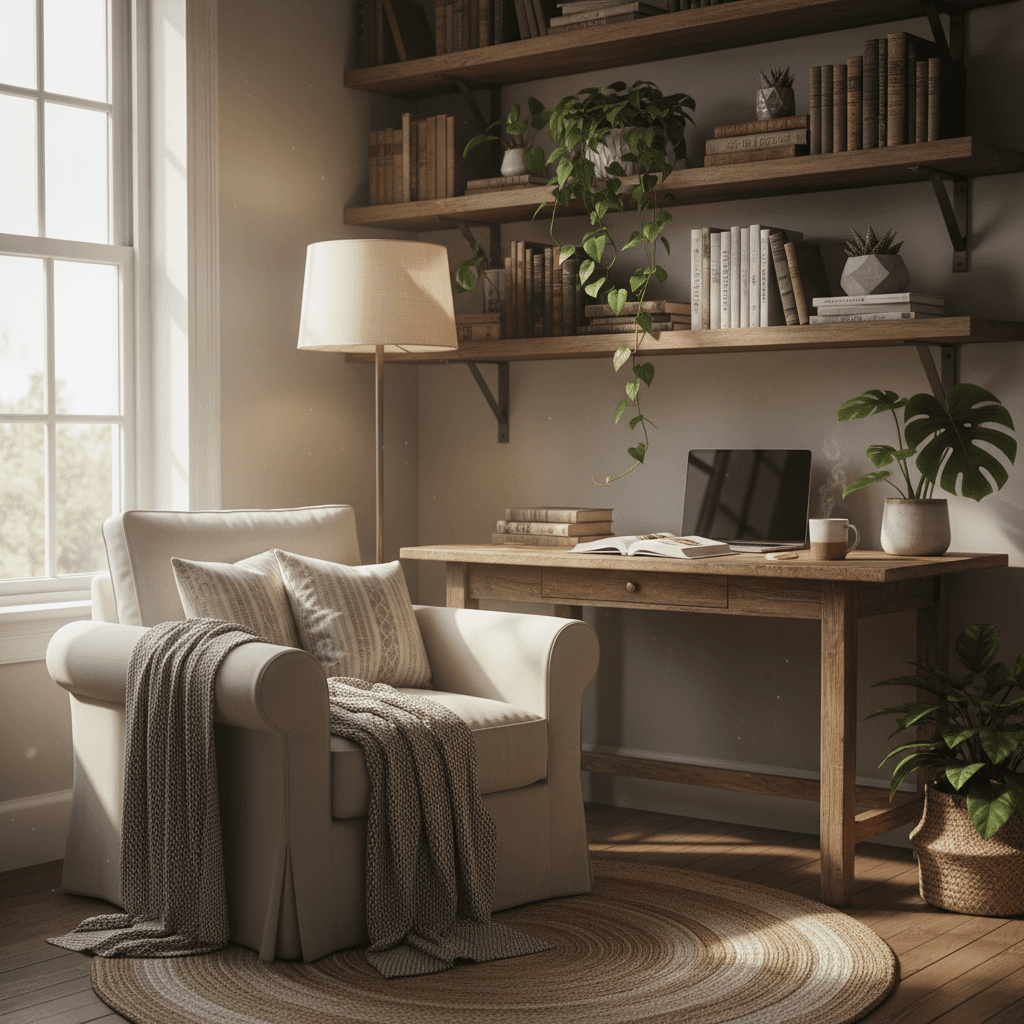
She decided to conduct an experiment. She dedicated a small corner of her bedroom solely to work. She bought a simple desk and a comfortable lamp. She established a ritual: a cup of tea, phone in the other room, and the same focus playlist on repeat. She used the Pomodoro Technique, working in 25-minute sprints, and used her break time to check her phone or do a quick chore.
The transformation wasn't instantaneous, but within a week, something clicked. That corner, her "thesis nook," became a trigger for deep work. Her writing output doubled, and the quality improved because she wasn't constantly re-orienting herself. She was no longer just spending time on her work; she was investing it. This deliberate practice is what leads to genuine memory improvement and mastery, because you're allowing knowledge to be encoded deeply, without interruption.
Your Invitation to Build a Better Way to Learn
Creating a distraction-free study environment isn't about deprivation. It's about liberation. It’s about freeing up your precious mental energy so you can pour it into what truly matters: learning, creating, and understanding. It’s one of the most compassionate things you can do for yourself as a student or an educator setting up a classroom.
The goal isn't to build a sterile, joyless prison. It's to create a space where you can do your best work efficiently, so you can then close the books, leave that space, and fully enjoy the rest of your life without guilt or a nagging feeling that you should be studying.
So, I have a challenge for you. This week, don't just try to "study more." Instead, invest one hour in designing your focus zone. Audit your space. Tame your digital distractions. Experiment with sound. Your brain—and your grades—will thank you for building a sanctuary designed not just for work, but for wonder.